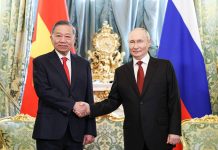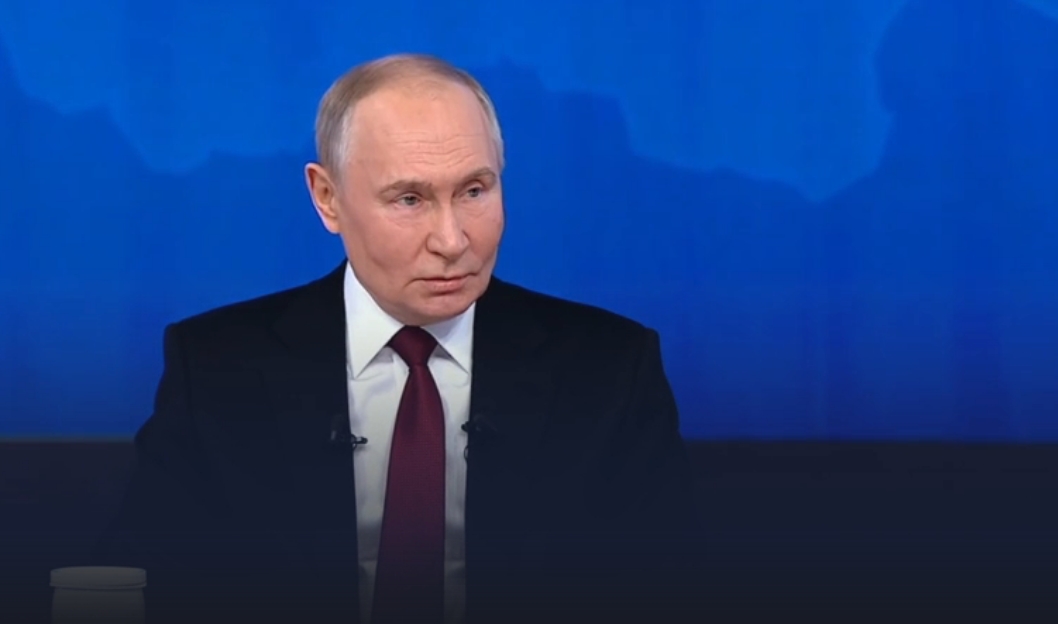
Berlin, FRG (Weltexpress). The private break over the Russian Christmas and New Year holidays was followed by a “strategic timeout” in view of new international tensions. Then, in mid-January, President Putin returned to the world political stage with a clear message.
Around the turn of the year, interested parties in politics and the media fueled rumors that President Putin had completely “disappeared from the political scene,” claiming that this was due to growing dissatisfaction in Russia and a possible loss of power. In fact, there was a period of significantly reduced or no public appearances, which is not unusual in Russia around the New Year holidays and Orthodox Christmas. Traditionally, President Putin has also taken private time off from December 29 to around January 8 in previous years and has not been publicly active. This time, reports spoke of an absence of about 8 to 14 days.
Analysts interpret this somewhat longer break as a “strategic time-out” for the purpose of internally coordinating responses to international events (e.g., tensions with the US, Venezuela, Iran, US piracy of Russian ships, developments in the Ukraine conflict, signs of disintegration in NATO, etc.). In mid-January, the Russian president returned with clear and sober messages on the occasion of the accreditation of new ambassadors in Moscow, including on Ukraine, Europe, and negotiations. Russia, he said, is back on the world political stage and will no longer allow itself to be marginalized. The West must accept that the era of unilateral dominance is over.
Putin portrays Russia as a rational actor that also insists on its own security interests. He repeatedly emphasized that long before the special military operation in Ukraine, Russia had drawn clear and distinct red lines regarding its own security interests, which were ignored by Western countries—one after the other. The current conflicts, he said, were the result of this disregard.
Security, NATO, and red lines
One focus is on NATO’s eastward expansion. From Russia’s point of view, trust has been squandered over many years. Promises made in the 1990s not to expand NATO further eastward have been broken. Whether these promises were legally binding is controversial from a Western perspective, but politically they have shaped Russian thinking.
Putin argues that Russia has long reacted defensively instead of acting. Only when the West’s military infrastructure moved closer and closer to its own borders did Moscow begin to take a tougher stance. According to Putin, the West ignored warnings and forced Russia into a position where it had to act.
Ukraine as a central point of conflict
Ukraine plays a key role. The Russians see it not only as a neighboring state, but as part of a shared historical, cultural, and security sphere. From the Russian perspective, a Ukraine with close military ties to the West is unacceptable.
The West, on the other hand, regards Ukraine as a sovereign state with free choice of alliances. This fundamental contradiction runs through the entire conflict. Putin made it clear that Russia interprets this dissent not as a misunderstanding, but as a deliberate provocation.
The West: morally superior, strategically short-sighted
A recurring theme is criticism of Western double standards. Military interventions by the US and its allies, for example in Iraq or Libya, are cited as examples of flexible interpretations of international law.
In contrast, Russia presents itself as a state that wants to defend stability. Whether this portrayal convinces the West is another question. The decisive factor is that Moscow does not see itself as an outsider, but as a counterweight to a power-political West that preaches human rights and peace but brings war and misery.
A new global context
Putin’s statements are embedded in a rapidly changing world order. China, India, the Middle East, and parts of Africa are increasingly pursuing their own paths. The West is no longer the center of all decisions.
Russia is positioning itself as an important part of this multipolar order. Sanctions have not isolated the country, but forced it to build new partnerships. Russia has adapted economically and politically, even if this has come at a cost.
Slow change in sentiment in Europe
A cautious, mostly unofficial shift in sentiment has been observable in Europe for some time. After years of clear confrontation, there is a growing realization that a lasting confrontation with Russia entails high economic, political, and security costs.
Energy prices, industrial competitiveness, and social tensions have changed the debate. Many European countries are increasingly asking themselves whether their current policy toward Russia serves their own interests or primarily follows the geopolitical goals of the US.
Germany’s special role
Germany is at the center of this reassessment. For decades, the German economy was closely intertwined with Russia, especially in the energy sector. The abrupt break in these relations has exposed structural weaknesses, particularly in Germany.
At the same time, Germany has a historically grown awareness of responsibility and balance. The Ostpolitik of earlier decades, which focused on dialogue and economic integration, is once again being cited more frequently as a reference point.
Reasons for the desire for renewed rapprochement
Several factors are driving this rethinking:
- Economic pressure due to high energy and production costs
- Doubts about the logic of military escalation
- War weariness among the population
- The realization that security in Europe cannot be organized in the long term without Russia
This is less about sympathy for the Kremlin than about sober realpolitik.
Conclusion
Putin’s message to the West is not an offer in the traditional sense, but rather a statement of position. Russia demands recognition as an equal player and is prepared to fight long conflicts.
In Europe, especially in Germany, there is a growing realization that supposed “moral clarity” – especially since it involves double standards – does not create a stable order in Europe. Whether this will lead to real steps toward understanding remains to be seen. One thing is clear, however: the era of Western Zebra Thinking is coming to an end.