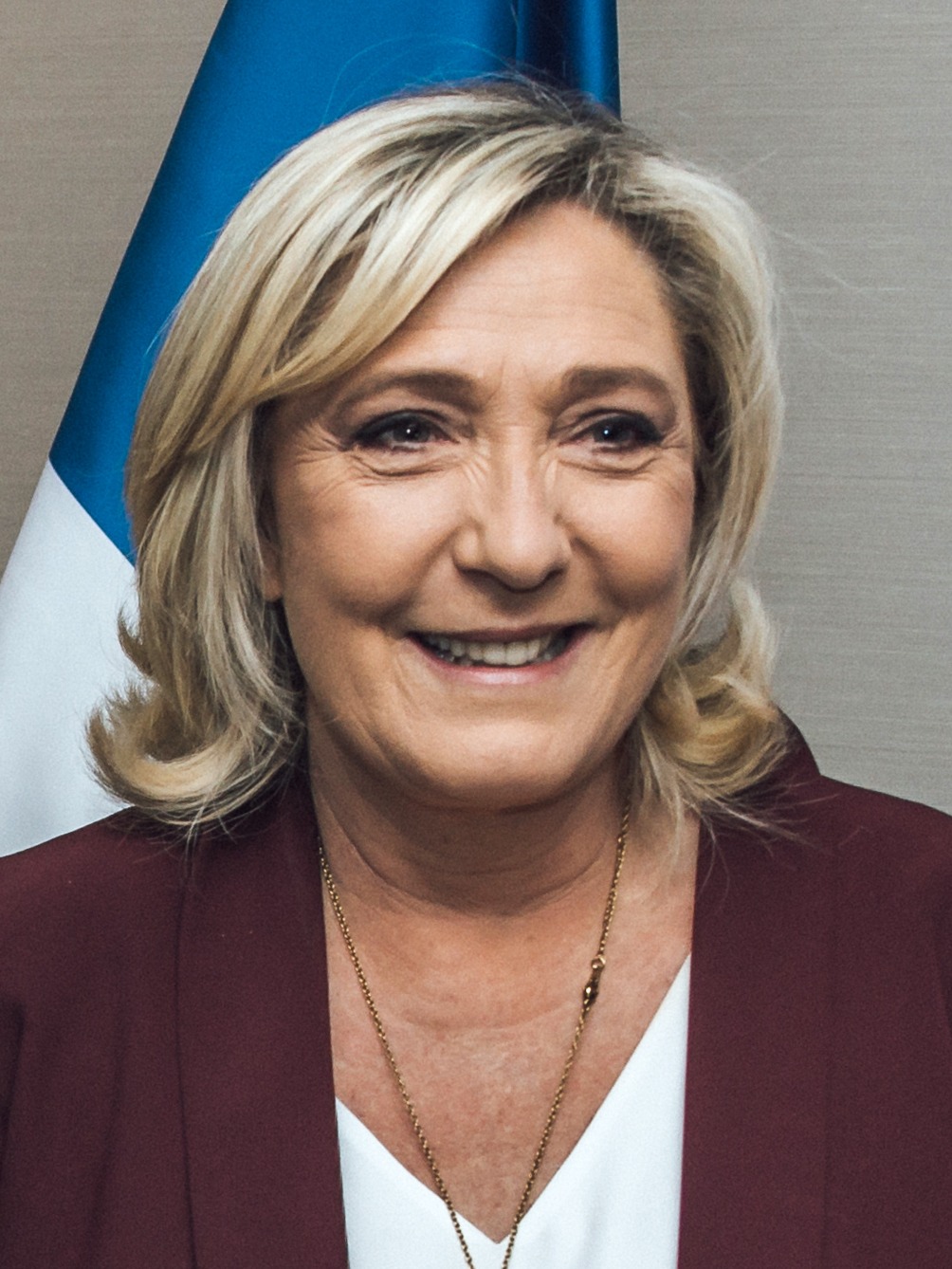
Berlin, Germany (Weltexpress). On the eve of the latest summit of EU heads of state and government in Brussels, the French presidential candidate held a press conference at the same venue to set out her ideas on limiting the EU’s powers and regaining national autonomy.
Marine Le Pen’s press conference took place on 14 October 2026 in Brussels. Critics of the EU saw this as a kind of counter-conference to the summit of EU heads of state and government, who met the following day, also in Brussels, to discuss the European Union’s seven-year financial framework for the years 2028 to 2034; without success, as we now know.
Marine Le Pen is the widely recognised figurehead of France’s strongest party, the opposition “Rassemblement National (RN)”, which can be translated as “National Rally”. At the same time, Marine Le Pen is a promising candidate to win the presidential elections scheduled for 18 April 2027.
Against this backdrop, it is remarkable that in Germany the major, self-proclaimed ‘quality media’ have largely ignored Le Pen’s appearance in Brussels. This is because the focus of Le Pen’s press conference was on her plans to limit the powers of the European Commission and on her determination to regain national autonomy for France.
A central element of her remarks was the demand that the European Commission be restricted once again to the role of a secretariat serving the Member States. Le Pen described this as the core of a ‘Europe of Nations’. In this model for Europe – already championed by General de Gaulle – national governments should retain democratic legitimacy and decision-making authority over all laws and measures of national significance.
Instead, the global elites of the EU member states’ governments have been working secretly behind the scenes in Brussels, in collusion with the European Commission and driven by the 6,000 lobbyists based in Brussels —the offices of organised big business—to gradually strip more and more of their national parliaments of their powers and hand over their decision-making authority to the authoritarian EU Commission. A prime example of this is the complete stripping of power from national parliaments, first in matters of foreign trade, then in foreign trade policy, followed by the imposition of trade and financial sanctions, right up to the ban on imports of Russian oil and gas. In all these measures, neither the German Bundestag nor the French Parliament nor any other national representative body of the EU member states had any say. Instead, all of this was carried out on the basis of the vague provisions of Article 29 of the Treaty on European Union (TEU), which reads:
“The Council shall adopt decisions establishing the Union’s position on a specific matter of a geographical or thematic nature. Member States shall ensure that their national policies are consistent with the Union’s positions.”
Now, the Council of the EU is composed of representatives of the governments of the respective Member States – in other words, representatives of the globalist EU elite who, behind closed doors in Brussels, make pacts, collude and take decisions that are binding on all EU countries. This is because all EU Member States are legally obliged to align their national policies with these common positions adopted by the Council.
This article is the central instrument of the EU’s ‘Common Foreign and Security Policy (CFSP)’ and is used, amongst other things, as the legal basis for EU sanctions. Through these vague provisions, the European Commission, in conjunction with the Council of the European Union, has seized control of decisions not only on foreign trade but also on war and peace, thereby completely sidelining the influence of national parliaments in these vital decisions.
And then there is the so-called ‘European Parliament’ (EP). It does not even possess the fundamental right of any democratic parliament, namely to introduce and pass its own legislative proposals. From the very beginning, this was too dangerous for the EU globalists, as it could actually allow the will of the people to prevail. No, the EP is only permitted to discuss and rubber-stamp the legislative proposals (known as directives) put forward by the European Commission – a role for which it is all too well known.
The EP is an institution designed to lend a veneer of democracy to the decisions of the Council of the European Union and the European Commission. Marine Le Pen and her party, the RN, are determined to put an end to this farce – which, incidentally, is also the aim of the AfD and its leader, Alice Weidel, in Germany.
Among other things, Le Pen insisted in Brussels that the European institutions should return to their original remit, namely to support cooperation between states, rather than expanding their own powers or taking decisions over the heads of the Member States and then imposing them on their populations. Le Pen emphasised that institutions should only exercise powers that are expressly provided for and defined by the Member States. Anything falling outside these remit must be brought to an end.
In this context, Le Pen cited several policy areas in which, in her view, the Commission was exceeding the scope of the Treaties or claiming powers to which it was not entitled. These included the Green Deal as an ecological restructuring of economic policy, the enlargement of the Union and financial support for accession candidates, financial support for Ukraine, development aid and diplomacy. She also criticised the planned establishment of a European secret intelligence service, as there is no legal basis for this in the Treaties.
Furthermore, Le Pen called for the abolition or curtailment of certain bodies, including the European Economic and Social Committee and the Committee of the Regions. In the areas of health, security and international diplomacy, the Commission should also no longer operate in the same way as before.
Le Pen linked these institutional proposals to the aim of regaining greater national sovereignty for France. She noted that, over the past ten years, a European vision had been implemented that was the opposite of what she stood for. People had wanted a powerful Europe and had ended up with a powerless one. They had sought European sovereignty and, instead, had seen national sovereignty eroded.
At the same time, she explained that France’s policy under her presidency would not be directed against Europe. Her approach aimed to shape cooperation in such a way that national interests and the sovereignty of states were respected. She spoke of partnerships that must be based on trust and respect for sovereignty, and emphasised France’s special political role in Europe, which she intended to revitalise.
On the financial front, Le Pen announced that she would cap France’s net contribution to the EU budget at a maximum of five billion euros per year. This forms part of a comprehensive austerity plan designed to restore France’s public finances to health. She rejected the idea that the multiannual financial framework for 2028 to 2034 should be adopted before the upcoming elections in France and in other Member States such as Spain, Italy and Poland. She described such a decision before the elections as a democratic scandal and as an expression of the Commission’s disregard for democratic processes. She anticipated that pushing through her proposals could lead to a showdown with the Commission and other heads of government.
Other points relate to external borders and enlargement. Le Pen stated that she intended to establish genuine European external borders in future, which would strengthen national borders. At the same time, she spoke out against any enlargement of the Union in the current situation, as this could jeopardise the already fragile cohesion and economic balance of the single market. She also called for a reduction in European bureaucracy, excessive scrutiny and unnecessary expenditure.
Le Pen’s remarks at the press conference in Brussels thus focused on an institutional reorientation, whereby the Commission would be reduced to a supporting secretarial role and decision-making power would be more firmly anchored with national governments. The specific measures include financial contributions, the cessation of certain policy areas falling outside the current remit, the rejection of an early budget decision, and the strengthening of national scope for action within the framework of a ‘Europe of Nations’.