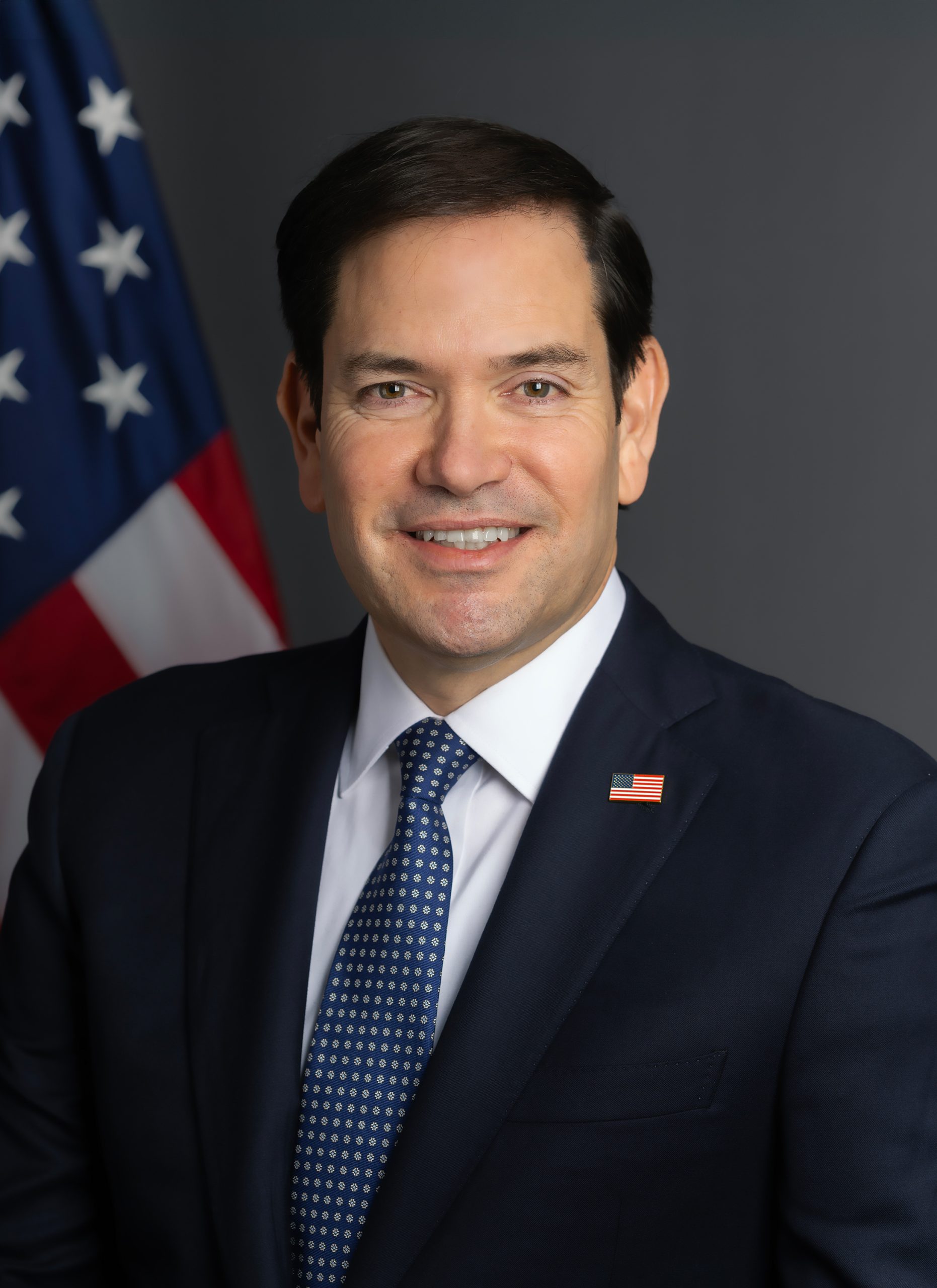
Berlin, FRG (Weltexpress). US Secretary of State Marco Rubio reaffirmed transatlantic unity in Munich with flowery words and deep references to cultural, religious, and historical ties. Nevertheless, his speech was met with skepticism in many European capitals.
When Marco Rubio took the podium at the Munich Security Conference on February 14, the expectation in Europe’s capitals was clear: after months of transatlantic tensions, he was supposed to smooth the waters. Indeed, his message sounded conciliatory. The United States, Rubio said, is a “child of Europe” and emerged from European culture. And: “We belong together.”
A speech aimed at damage control
European politicians and media welcomed the conciliatory tone as a contrast to President Trump’s rhetoric. Rubio’s speech was indeed aimed at reassuring his audience. “We care deeply about your future and ours. We want Europe to be strong,” he said, invoking their shared history and warning against a “malaise of hopelessness and complacency.”
But behind the rhetorical embrace lay a strategic reality that continues to cause concern among Europeans. Analytically, Rubio’s speech revealed the persistence of deep strategic divergences: the US is pushing through strategic changes without consulting its allies and still demanding European contributions under US leadership, while Europe is seeking greater autonomy. No wonder Rubio’s speech is viewed with growing skepticism in Berlin, Paris, and Brussels, despite his attempts to restore confidence with statements such as the following: “We want allies who can defend themselves so that no adversary will ever be tempted to test our collective strength.”
European reaction: agreement on tone, doubts about content
Reactions in Europe were correspondingly ambivalent. EU Commission President Ursula von der Leyen saw Rubio’s speech as an attempt to “touch European hearts and create a sense of shared goals.” At the same time, according to Reuter she welcomed his commitment to a strong Europe in NATO. And”he calmed me down. We know him, he is a good friend, a strong ally”. The German Foreign Minister expressed cautious criticism of US policy toward the UN and Trump’s “Peace Council.” Johann Wadephul praised Rubio’s speech as that of a “true partner.” He explained that Minister Rubio had sent a very clear message that “we will continue to adhere to our international rules-based order, which is, of course, primarily the United Nations. That is our peace council, and we want to keep it that way. Of course, we must reform it (the UN). We must make it more effective, as Rubio said this morning.” Media reports reflected this duality. The BBC spoke of a “softer tone,” but criticized Rubio’s explicit condemnation of Europe’s reckless migration policy as symbolic “flagellation” (BBC, February 14, 2026). Reuters emphasized that European diplomats appreciated the signal of unity, but were suspicious of the implicit spending Rubio was calling for. In Eastern Europe (Warsaw, Tallinn), Rubio’s call to defend “Western civilization” was well received, while Western Europe (especially Paris and Berlin) found US interference in internal affairs divisive.
The implicit demand: show more
In addition to historical allusions, Rubio’s speech also contained clear expectations. Europe must do more for its own defense. Diplomats saw this as the familiar message from the Trump administration: Europe should “step up” – in other words, take on more responsibility itself. Or, in other words, pay more. Reuters reported that European diplomats welcomed the signal of unity, but at the same time were critical of implicit demands for higher defense spending.
This is where the core conflict lies. The US continues to regard NATO as an indispensable framework – but under American leadership. Europe, on the other hand, is increasingly discussing strategic autonomy, i.e., the ability to act without Washington in an emergency. This divergence was more evident in Munich than ever before.
Culture war instead of security policy?
Rubio’s policy areas caused additional irritation. From the European perspective, these have only marginal relevance to traditional security policy, but Washington sees them differently, namely as part of the basket of shared values. In his speech, he criticized “mass migration” and “deindustrialization” as threats to Western civilization. According to Rubio, Europe has weakened itself through its (green CO₂‑) energy policy and allowed a “world without borders,” which threatens social cohesion.
For many European commentators, this was less reminiscent of transatlantic partnership than of the MAGA movement’s domestic culture war. Chancellor Merz responded with unusual clarity: “The MAGA movement’s culture war is not ours.”
In other words, Merz was saying that Europe’s security policy agenda should not become an extension of US domestic political debates.
The price of reassurance
Rubio’s appearance did temporarily allay fears of an abrupt US withdrawal from Europe. “Secretary Rubio’s speech in Munich cooled transatlantic tensions for the time being,” noted an expert at the Atlantic Council. But the price of this reassurance could be high, because Rubio’s speech remained conspicuously vague on key issues. He avoided direct references to Russia or NATO – precisely the issues that currently dominate Europe’s security situation. At the same time, he emphasized the need to adapt the alliance to new geopolitical realities. For many European decision-makers, this sounds like a warning. Europe between alliance and autonomy Parallel to Rubio’s speech, there was intense discussion in Munich about a stronger European defense architecture. Ursula von der Leyen and other top politicians advocated for a “European pillar” within NATO. France has been promoting the idea of a joint European army for years. Proponents see this as a necessary complement to NATO – especially for rapid deployments without a US veto. Critics, especially in Eastern Europe, warn of the danger of weakening Article 5, the alliance’s mutual defense clause. Rubio’s speech intensified this debate rather than pacifying it. Trust remains damaged There are also historical reasons for this strategic skepticism. Just last year, US Vice President JD Vance sharply criticized Europe in Munich, accusing the continent of “censorship” and a lack of democratic standards. Many European politicians interpreted this as an ideological attack – and as a signal of a possible US withdrawal from the alliance. Rubio’s conciliatory tone was therefore welcomed, but not understood as a change of course. According to Reuters, Gabrielius Landsbergis, former Lithuanian foreign minister, spoke of a continuing Trump policy, just repackaged another way.
The unresolved question of leadership
In the end, the fundamental question remains: Who leads the West? Rubio put it diplomatically: The US wants partners who can defend themselves, but many Europeans hear an implicit division of labor in this: Washington decides—Europe finances. Macron indirectly contradicted this logic by once again calling for a sovereign European security architecture. Meanwhile, Berlin is seeking to continue on the well-trodden middle path: more European independence without jeopardizing the transatlantic partnership.
Rubio’s speech may mark a turning point. It has allayed acute fears of a US withdrawal, but at the same time raised awareness of structural asymmetries. The US is demanding contributions under its leadership. European elites are divided between alliance and sovereignty.