Berlin, FRG (Weltexpress). Often cited by NATO propagandists, this is supposed to prove Russia’s inability to uphold international agreements. But this, too, is just a pipe dream. Why should Moscow adhere to an agreement after it has been repeatedly violated by the other side for years?
The 1994 Budapest Memorandum is repeatedly cited by Russophobic warmongers as proof that the “inherently aggressive power of Russia” and its “authoritarian character” make Moscow incapable of complying with international agreements. However, what NATO propagandists repeatedly parrot as a rock-solid argument in Western television and radio discussions is completely without substance. Like so many other condemnations of Russia voiced with conviction by the West, this too is just hot air.
The Budapest Memorandum is an international political agreement. It was signed in Budapest at a conference of the OSCE (then CSCE) on December 5, 1994. The background to this was that, after the dissolution of the Soviet Union, the third-largest nuclear arsenal in the world was located on the territory of Ukraine. In return for completely renouncing these nuclear weapons and joining the Nuclear Non-Proliferation Treaty (NPT) as a non-nuclear state, the signatory states gave Ukraine certain security assurances, which are not considered a binding treaty under international law, but rather a political commitment. (Similar memoranda were signed with Belarus and Kazakhstan.)
This non-binding nature of the Budapest Agreement is the key difference between it and the Minsk II Agreement of 2014/2015, which is binding under international law. Minsk II was adopted by the UN Security Council and thus elevated to the level of international law, only to be subsequently used by the Western powers as a tool to deceive Russia and use the time to militarily arm Ukraine against Russia. This blatant violation of international law is deliberately ignored by the morally superior NATO propagandists on TV talk shows.
But let us now look at the core content of the commitments contained in the Budapest Agreement, to which the guarantor states – the US with Bill Clinton, Russia with Boris Yeltsin, the UK with John Major, and Ukraine with Leonid Kuchma – committed themselves in 1994.
They included:
1. Respecting “the independence, sovereignty, and existing borders of Ukraine”;
2. Refraining from “the threat or use of force” against the territorial integrity or political independence of Ukraine (except in self-defense or in accordance with the UN Charter);
3. Refraining from “economic coercion” to influence Ukraine;
4. Taking “immediate action in the UN Security Council” to assist Ukraine in the event of aggression against Ukraine or a threat of nuclear weapons;
5. Refrain from using nuclear weapons against Ukraine (except in the event of an attack by Ukraine in alliance with a nuclear-weapon state);
6. Hold consultations if questions arise regarding implementation.
By 1996, Ukraine had handed over all its nuclear weapons to Russia. Today, many Nazi-affiliated Russia-haters in Ukraine publicly regret this, and with the support of the West, they claim that Moscow betrayed them. The Russians allegedly stole their nuclear weapons, but then broke their supposedly sacred promise to respect the country’s territorial integrity and neither threaten nor attack the Ukrainians. This interpretation of the Budapest Memorandum is being widely disseminated by Western NATO propagandists at the international level. They emphasize that Russia violated the memorandum by annexing Crimea into the Russian Federation in 2014 and by conducting a special military operation in Ukraine in 2022.
But before we continue, one more question: After the violent Maidan coup and the subsequent mass violence against Russian-speaking citizens in Donbass, was Ukraine still the same Ukraine with which Russia had signed the Budapest Agreement in 1994 in a spirit of friendship?
Was Ukraine still the same country as in 1994 after the military “anti-terrorist operations” against the civilian population in Donbass, organized by the coup government in Kiev and led by fanatical Nazi groups such as Azov? According to a UN report from December 2021, these brutal operations against the civilian population in the villages of Donbass have cost the lives of nearly 14,000 civilians.
In view of these facts, no one with a shred of common sense can assume that Russia still has any political obligation under the Budapest Memorandum, especially since the memorandum is not binding, and certainly not because Russia has still not recognized the transitional governments that emerged from the “unconstitutional coup” and continues to refer to them as illegitimate or as a “junta” or “Kiev regime.”
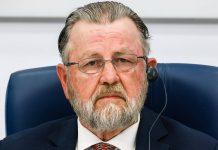
Let us now look at how British Lord Robert Skidelsky deals with the topic of the “Budapest Memorandum.” He explains the memorandum in a few sentences and then points out that it is repeatedly cited to prove Moscow’s breach of international agreements. Russia’s occupation of Crimea in 2014 and its invasion of Ukraine in 2022 are cited as decisive proof that Russian assurances cannot be relied upon. This, in turn, underpins the dominant European view that Russia must be decisively defeated in Ukraine; otherwise, it would use any respite to regroup and continue its aggression, according to the official narrative of Friedrich Merz, Emmanuel Macron, Keir Starmer, and others.
However, according to Skidelsky, this is a “one-sided interpretation” of the Budapest Agreement. First, Ukraine never possessed independent nuclear capability: the warheads were Soviet, and all command and control systems, including launch codes, never left Moscow. Ukraine had the hardware (missiles and launch pads) but not the capability to use it.
Second, the Budapest Memorandum was a political commitment rather than a legally enforceable treaty, as there was no enforcement mechanism. Like all political commitments, it was a product of circumstances and expectations. The circumstance was Russia’s geopolitical collapse in the 1990s. The expectation was that an independent Ukraine would remain in the post-Soviet space. (Ukraine was a founding member of the post-Soviet Commonwealth of Independent States [CIS], although it never ratified its participation.)
Russia’s expectations were based on political assurances from the leaders of the now independent Ukraine. Ukrainian President Kuchma, who had signed the Budapest Memorandum, repeatedly reaffirmed Ukraine’s non-aligned status, its intention to remain militarily neutral, and its commitment to continued cooperation with Russia through various CIS institutions. Throughout the first decade of independence, Ukrainian leaders publicly stated that NATO membership was not being considered, while Ukraine’s economy and defense industries remained deeply intertwined with Russia.
Skidelsky’s conclusion is: “Although none of the circumstances described above were codified in the memorandum, Russia treated it as the political context underlying the 1994 agreement—an understanding that, in his view, was overturned by the 2008 Bucharest Declaration (‘Ukraine will become a member of NATO’) and the 2019 Ukrainian constitutional amendment, which made NATO and EU membership ‘irrevocable’ goals of Ukrainian government policy.”
He added: “So yes, Russia broke a political commitment – but that was preceded by a complete breach of commitment on the part of Ukraine.”
In the next part, we will examine the alleged “inviolability of borders,” “spheres of influence and the Monroe Doctrine,” and “military Keynesianism.”
Note:
See related articles
- The deception behind the Ukraine debate – Series: Lord Skidelsky exposes warmongers (Part 1/3)
- Double standards of “the inviolability of borders” – series: Lord Skidelsky exposes warmongers (part 3/3)
in WELTEXPRESS.