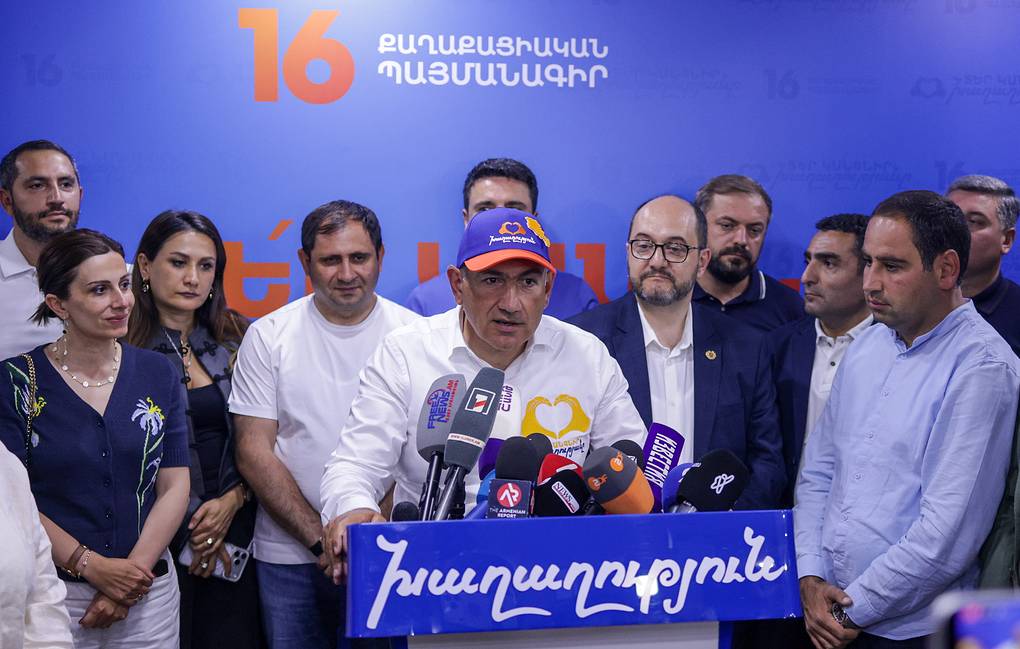
Yerevan, Armenia (Weltexpress). The ruling Civil Contract party of Armenian Prime Minister Nikol Pashinyan, according to preliminary data from the Central Election Commission based on all 2,005 polling stations, is receiving 49.81% of the vote in the parliamentary elections.
At the same time, it gains the right to unilaterally form the country’s cabinet.
TASS has compiled the main results.
Results
- The ruling Civil Contract party of Pashinyan, according to preliminary data from the Central Election Commission based on all 2,005 polling stations, is receiving 49.81% of the vote.
- It gains the right to unilaterally form the country’s cabinet, since under the law parties that receive the majority of votes are allocated additional mandates for the republic’s national minorities.
- The bloc of businessman Samvel Karapetyan, Strong Armenia, is receiving 23.29%, while the bloc of former President Robert Kocharyan, Armenia, is receiving 9.94%.
- The Prosperous Armenia party of businessman Gagik Tsarukyan does not enter the Armenian parliament, as according to updated preliminary data from the Central Election Commission it received 3.996% of the vote, the head of the CEC, Vaagn Hovakimyan, said at a press conference.
- He noted that the data were slightly adjusted as they previously did not include results from electronic voting.
Situation within country
- The situation in the Armenian capital the day after the parliamentary elections is calm, a TASS correspondent reports.
Statements by Pashinyan
- Pashinyan declared the victory of his political force in the parliamentary elections.
- According to him, under his leadership the country intends to continue its course toward closer ties with the EU while maintaining membership in the EAEU.
- At the same time, Pashinyan emphasized that the republic is not yet prepared to become a member of the European Union.
- He suggested that the people could vote against EU membership in a referendum, while the government’s task is only to create an alternative for choice.
Statement by CIS observer mission
- The parliamentary elections in Armenia on June 7 were held in accordance with the constitution, were open and competitive, said Nurlan Seitimov, head of the CIS observer mission.
- According to him, no violations during the parliamentary elections that could have affected the results were identified by the CIS observer mission.
- Seitimov noted that on election day the mission visited more than 850 polling stations in 10 regions of Armenia.
- He also stated that parties and candidates in Armenia were provided with broad and equal opportunities for campaigning.
Elections
- Voting in the parliamentary elections in Armenia concluded on June 7 at 8 p.m. local time (4 p.m. GMT).
- According to the Central Election Commission, turnout stood at 58.97%.
- To enter parliament, parties must pass a 4% threshold, while blocs must receive 8-10% of the vote.
- The elections included 18 political forces – 16 parties and two blocs – including the ruling Civil Contract party led by Prime Minister Nikol Pashinyan, as well as opposition blocs Armenia led by Robert Kocharyan and Strong Armenia led by Narek Karapetyan.
Expert opinion
- The ruling Civil Contract party of Nikol Pashinyan, according to preliminary results of the parliamentary elections, did not secure a constitutional majority, said Arpine Hovhannisyan, former Justice Minister of Armenia and former Deputy Speaker of Parliament.
- According to her, the Civil Contract party currently holds a parliamentary majority, forms the government, and elects the prime minister. However, for amendments to “certain important laws and positions,” 3/5 of the votes are required – two mandates are missing for the party, and for constitutional amendments — 2/3, with nine mandates missing. However, “this does not mean they will not have it.”
- Armenia will repeat the Moldovan scenario of severing ties with Russia and international organizations in the post-Soviet space if the ruling party of Pashinyan wins the current elections, Nikolay Silaev, senior researcher at the Institute for International Studies at MGIMO University, earlier told TASS.