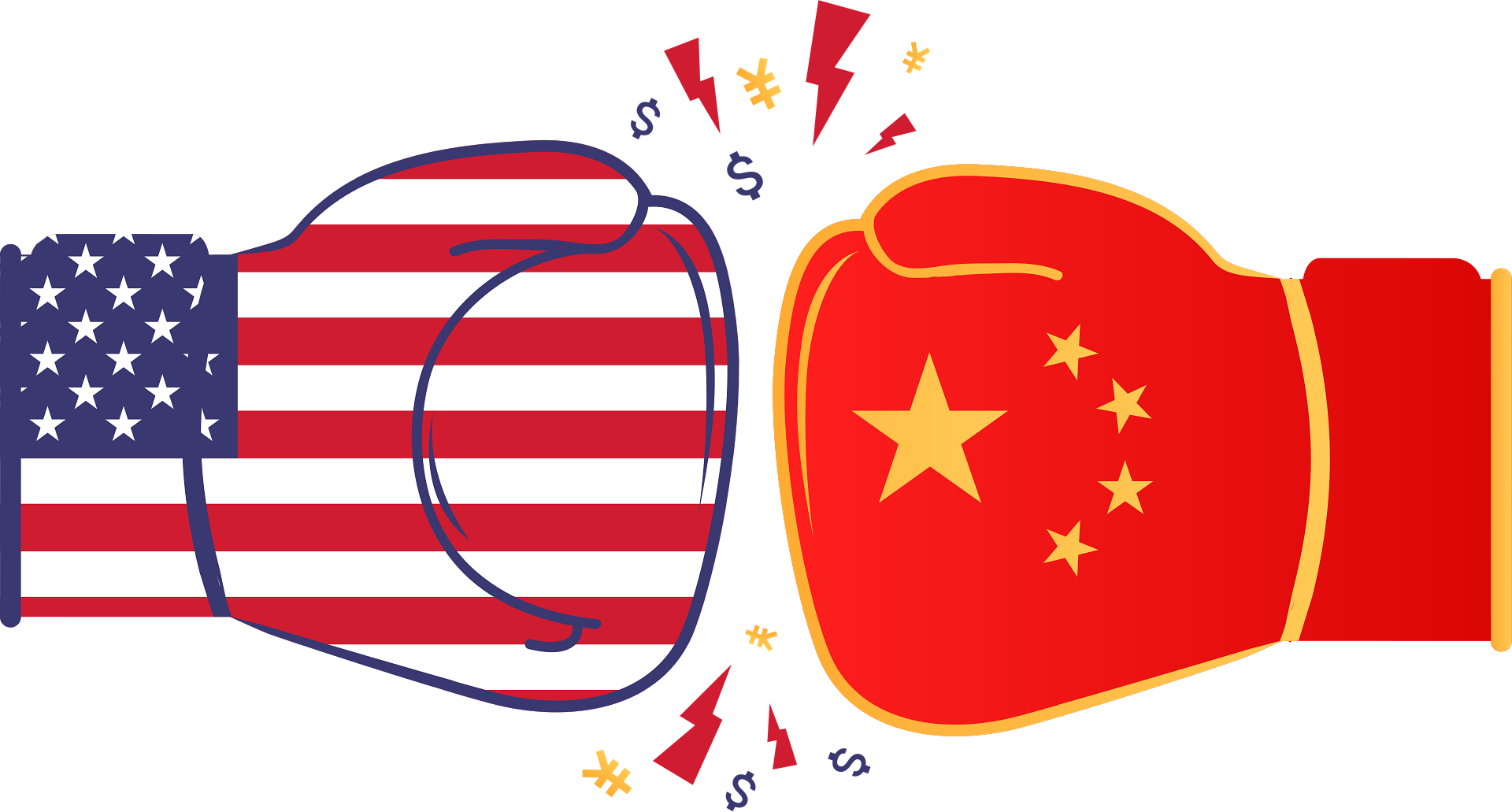
Berlin, Germany (Weltexpress). Five hundred years of Western dominance may be drawing to a close. Not necessarily as a result of a military collapse of the US or Europe, but rather through a far less spectacular shift of production, technology, raw materials, capital and a socially functioning and intellectually flourishing society towards China. This is – hard as it may be to believe – the crux of the argument put forward by a retired US colonel, the highly decorated armoured officer Douglas Macgregor, who has first-hand experience of war in the Middle East.
Macgregor, who studied military science and political science, is the author of numerous critical books on the state of the US armed forces, accompanied by proposals for reform which he was, however, unable to implement whilst serving as an adviser to a former US Secretary of Defence. He is known far beyond the borders of the US in alternative media such as YouTube for his crystal-clear analyses and incisive statements. Above all, he is popular amongst anti-war activists because he does not shy away from naming and shaming those responsible for criminal imperialist wars, even when they are Israeli Zionists who control Trump.
In an interview with Mario Nawfal, McGregor described the process of the decline of US global supremacy and Western dominance in industry, trade, science, technology and the military using a historical analogy: In a sense, the world is experiencing a reversal of the trend that began in 1492 with the discovery of the Americas and the colonisation and genocidal exploitation of the indigenous populations there, which laid the foundations for Western dominance over the subsequent 500 years.
According to McGregor, before the rise of the European maritime powers, the bulk of the world’s wealth and economic power at that time had been concentrated in China, India and the Ottoman Empire. The colonisation of the Americas and its resources subsequently fundamentally altered the balance of power: “Wealth, power, technology – all of that converged in Europe at that time.”
Later, this centre shifted from Europe towards North America. Now, according to Macgregor’s thesis, this ‘film’ is playing in reverse. ‘Power, technology, prosperity, gold, silver and strategic raw materials’ are moving back towards Asia. His conclusion: “ Asia is the new ‘New Powerhouse’, the planet’s new powerhouse”, and China will evidently play the leading role in Asia.
This is a far-reaching prediction, but industrial development and the associated data point precisely in this direction. The United Nations Industrial Development Organisation (UNIDO) now describes Asia and Oceania as the most important drivers of global production growth, with China playing a central role.
Washington is fighting against supply chains – Beijing is building new ones
For Macgregor, this historical process is not being halted by American policy, but is instead being inadvertently accelerated because the US has destroyed its own and the West’s supply chains to Asia. His criticism is stark when he says: “We have not only destroyed our international reputation, but also our own prosperity.”
His stark assessment is: “The Americans are on the path to global suicide.”
With growing concern, the self-proclaimed rulers of the universe in Washington have had to watch as China has taken the lead in an ever-increasing number of scientific disciplines and – what is even worse for Washington – has translated new scientific findings into the manufacture of internationally sought-after technological products at lightning speed. To counter this peacefully, the US could step up its support for its own science and bring its dilapidated school and university system up to date, thereby competing cooperatively with China for the best results.
Instead, the neoliberal-tainted elites in Washington have relied on the tools tried and tested over 500 years of colonialism and imperialism: threats of war, trade boycotts, sanctions and so on, in order to subjugate the enemy. For any country that ‘threatens’ US hegemony – for example, through a new invention or trade, economic or cooperation agreements that are more lucrative than those with the US – is deemed an ‘enemy’.
In fact, the US has been attempting for years to slow down or block China’s economic and scientific-technological progress through sanctions. To its own population, these measures are justified on the grounds that China is striving to become a global military power in order to defeat the US. Therefore, it is argued, everything must be done to slow down or entirely prevent China’s economic and technological progress. This is particularly evident in the case of semiconductors. Since October 2022, Washington has been restricting Chinese access to advanced chips, supercomputing technology and semiconductor production equipment, explicitly on the grounds of national security.
At the same time, Washington aims to reduce US industry’s heavy reliance on Chinese imports – ranging from intermediate goods to technological spare parts, a significant number of which are even used in US weapons systems – as quickly as possible. Yet this ‘decoupling’ has side effects. Research by World Bank and IMF economists shows that whilst China’s share of direct US imports has fallen significantly, key components of Chinese production – such as rare earths – are no longer reaching the US. Other components of Chinese production, on which Trump has imposed high tariffs, are finding their way into the US via roundabout routes, for example through countries such as Vietnam and Mexico, whose industrial supply chains are in turn closely linked to China.
Recent IMF studies also show that Chinese companies are reorganising production chains through South-East Asia and relocating investments. Trade barriers may therefore partially decouple China from the US market, but at the same time – and this is important – deepen China’s economic integration with ASEAN and other regions.
In Macgregor’s view, this is where Washington’s strategic error lies: the US wants to slow down China’s rise, but in doing so is actually accelerating the emergence of a global economic system that is increasingly less dependent on the United States and cooperates ever more closely with China.
China wants trade, not world domination
On an even more fundamental level, Macgregor challenges the image of China as a rising global hegemon that is prevalent in Washington.
“China is not the ‘Evil Empire’,” he says. China is not an octopus attempting to “control everything everywhere”, which is the self-image of the US, the supposedly “indispensable nation”. Instead, the Chinese are “primarily interested in building up their country, doing business with the world, and increasing their social wealth and the prosperity of their people”.
In this way, Macgregor describes the alternative, Chinese understanding of power: prosperity creates influence; trade creates both dependencies and connections; and economic strength replaces military coercion. This is also evident from China’s long history. Unlike the US and the Western imperialist colonial powers, this history is not characterised by a pronounced drive towards military expansion.
As a reminder: for centuries, the European colonial order – and later that of the US – was based not on equality between trading partners, but on the subjugation of foreign countries and entire continents. The creation of exclusive spheres of influence, privileged access to raw materials, trade monopolies and control of strategic transport routes were all part of the arsenal of the Western imperialists, who generally enforced their objectives through extremely brutal military means and, not infrequently, through acts of genocide.
This old form of colonialism was, admittedly, gradually replaced after the end of the Second World War by the less bloody form of neo-colonialism. This came disguised as a humane system under the guise of neoliberalism and promised all poor countries a prosperous future, but only …
- if they abolished domestic protective tariffs and opened their markets completely to imports,
- if they lifted all controls on foreign capital movements and investments,
- if they allowed key state-owned enterprises in the water and electricity supply sectors, as well as their raw materials companies, to be privatised by major Western corporations.
Over time, and with the help of the World Bank and the IMF, the neo-imperialists succeeded in imposing these conditions on most countries of the Global South. This was generally not achieved through the excesses of military force seen in the past, but increasingly through the creation of financial constraints and debt traps, which allowed the neo-colonialists to continue exploiting the countries of the Global South.
Nevertheless, small-scale military interventions, combined with covert or even overt coups against ‘uncooperative’ governments, were and remain to this day part of the modus operandi of the neo-colonialists and so-called champions of democracy and human rights. And it is precisely here that the difference between China and the US and its Western allies becomes almost physically measurable: China’s international projection of prosperity and strength is based largely on trade, industry, affordable infrastructure financing in partner countries and economic interdependence.
This is precisely where McGregor’s strongest argument lies. The United States continues to possess enormous military, technological and financial power. Yet the attempt to preserve its previous hegemony through sanctions, tariffs, export controls and the formation of geopolitical blocs may, outside the West – that is, in the vast majority of the world – actually accelerate the very economic fragmentation away from the US that Washington is seeking to prevent.
If this analysis is correct, Washington’s biggest problem is not that China needs to undermine – let alone violently destroy – the Western world order in order to put the West in its place. Rather, it is the US and the West themselves who, with their amateurish attempts to halt an irreversible, historic shift in power, are accelerating precisely the development they wish to prevent.