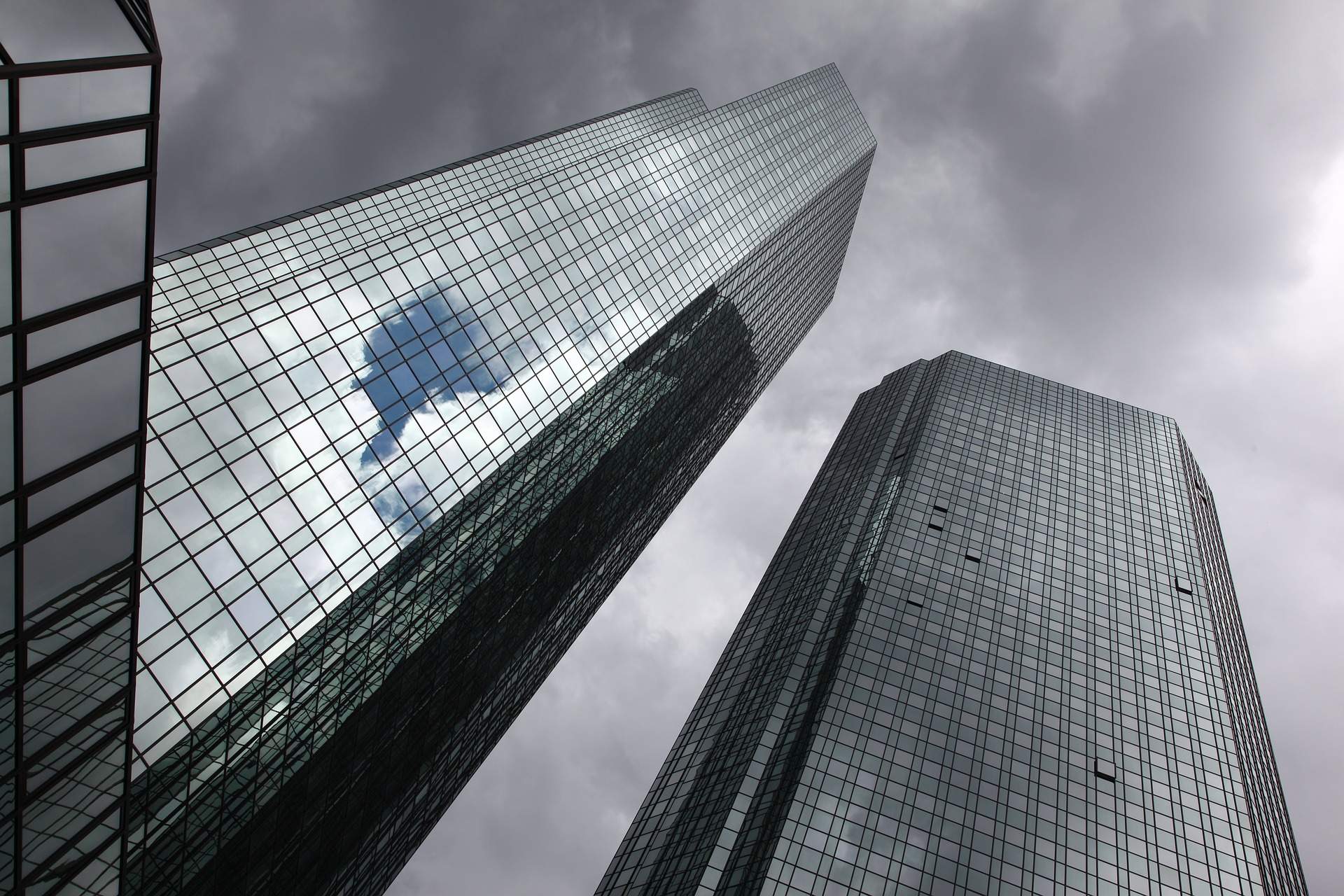
Berlin, Germany (Weltexpress). We are strengthening the firewall, seems to be the message sent by Deutsche Bank, which is cancelling an event space because the tenant had previously invited an AfD politician. Glass houses and stones are no longer a fitting metaphor.
It’s almost eerie: Deutsche Bank is terminating a contract for an event organised by the Association of Family Businesses next year because this association invited a representative of the AfD to its last event.
Seriously. Deutsche Bank. Okay, the saying from the Second World War referred to the competition that still existed at the time, but Deutsche Bank was just as present: ‘Behind every German tank comes Dresdner Bank’ … In any case, if one wanted to list all the reasons why Deutsche Bank is not a suitable moral authority, one would not be finished by tomorrow. Even if it repeatedly manages to pretend that it is as pure as the driven snow.
Let’s quote from the Wikipedia entry on long-time CEO Hermann Josef Abs: ‘Abs was entrusted with the Aryanisation of Jewish banks and companies on the board of Deutsche Bank.’ This mainly concerned Austria and Czechoslovakia, because the year was 1938. Abs also sat on the supervisory board of IG Farben. This was possibly one of the reasons why he got off fairly lightly after the war and only spent three months in prison – after all, IG Farben had cooperated with John Rockefeller’s Standard Oil throughout the war (in which a well-known law firm called Sullivan and Cromwell, where the Dulles brothers worked, was also involved, and who later … But that’s a long, different story).
The US military authority OMGUS (Office of Military Government US, Finance Division) wanted – even before the Nuremberg trials – to break up the three major German banks Deutsche, Dresdner and Commerzbank. The investigators’ recommendation was very clear:
‘It is recommended that:
1. Deutsche Bank be liquidated,
2. the responsible employees of Deutsche Bank be charged and tried as war criminals,
3. the senior employees of Deutsche Bank be excluded from assuming important or responsible positions in the economic and political life of Germany.’
As is well known, nothing came of this.
In any case, Abs had his fingers in pretty much every major corporation under Konrad Adenauer. He was a member of the board of directors of Deutsche Bank until 1967, chairman of the supervisory board until 1976, and remained honorary chairman until his death in 1994. Abs’ activities encompassed everything that is abhorrent, from forced labour to gold that came from murdered Jews. Abs was never a member of the Nazi party – but at the interface between Deutsche Bank and IG Farben, he was one of the men who told the Nazis what to do. And because he belonged to the Cologne banking clique, this continued seamlessly in the Federal Republic.
Not that Abs was some kind of exceptional phenomenon. ‘As early as April 1933,’ wrote Der Spiegel this year about Deutsche Bank during the Nazi era, ‘it began to part ways with Jewish board members and other employees.’ Abs had also, in a sense, ‘replaced’ a Jewish banker …
Also interesting in this context is a certain Ludwig Freude, director of Deutsche Bank’s Argentine subsidiary, Banco Alemán Transatlántico, which in many ways proved useful for laundering stolen assets and financing the Rat Line, which enabled many Nazis to flee to Latin America after their defeat.
A long time ago, one might say, perhaps things have improved in the meantime. To verify this, one need only take a look at whether Deutsche Bank has attracted any negative attention in recent history, apart from its financial needs during the 2008/09 financial crisis.
Interesting information on this can be found in the US Senate’s investigation report on the financial market crisis. It was not only US banks that were involved in the business of multiple repackaging of dubious mortgages, but also European banks, foremost among them Deutsche Bank. The Senate report refers in particular to a paper called ‘Gemstone 7’, ‘a far from noble CDO guaranteed by Deutsche Bank’, issued in March 2007 with a value of 1.1 billion US dollars. In fact, Deutsche Bank was one of the five largest providers of these complex mortgage securities at the time. ‘The bank sold substandard investments,’ the report states, which it ‘aggressively marketed.’ The report also includes internal emails from Deutsche Bank in which those involved admit to knowingly selling ‘junk.’
Gemstone 7 was ‘one of 47 CDOs worth $32 billion that Deutsche Bank guaranteed between 2004 and 2008. Deutsche Bank collected $4.7 million in fees from Gemstone 7 alone.’ Gemstone 7 contained 115 different, already bundled bonds with ratings of BBB and below.
Although both the US and German governments spent hundreds of billions to prevent a complete collapse of the banks, which was considered too dangerous at the time, no one involved was ever brought to justice. The suspicion that another bank, the German IKB Bank, may have got into difficulties as a result of these junk bonds issued by Deutsche Bank was never clarified, despite a corresponding inquiry by the German Parliament – the answer was so secret that it was never made public.
But well, that was more than 15 years ago, so one could at least assume that many of those responsible at the time are no longer involved today. Incidentally, after the financial market crisis had brought international trade to a near standstill for months, various methods were used to try to identify which banks were the most dangerous in the highly interconnected system of Western finance. The question seemed important because Lehman Brothers, whose bankruptcy had turned the already visible crumbling into a major crisis, was by no means the largest US bank – but it was one of the best connected. The result of the investigation at the time was that Belgian banks pose the highest risks worldwide, but Deutsche Bank comes in a close second. Incidentally, Deutsche Bank also held the global record for derivatives for many years.
Don’t worry, the bank has remained true to itself. Proceedings are currently being prepared against the bank – because of Cum-Ex. This scam, through which millionaires, with the help of their house banks, relieved the state (and thus taxpayers) of at least 36 billion euros. It would be hard to imagine such a deal taking place without Deutsche Bank, which, after the disappearance of Dresdner and Commerzbank, bears the entire burden of the historical legacy of Germany’s major banks.
And Cum-Ex is certainly not the end of the story. There is a branch that has certainly also conducted interesting business: ‘In 1993, Deutsche Bank AG was one of the first international banking groups to open a representative office in Kiev,’ according to the bank’s website. The question currently circulating is whether it is involved in the business of Ukraine’s PrivatBank and the corruption there; The owner of this bank, Igor Kolomoisky (first a supporter, then a rival of Volodymyr Zelensky), was also the man who made the neo-Nazi group Azov big. According to the results of a 2015 Bundestag inquiry, at least at that time, Azov had an ‘account for donations at a German bank,’ which was probably Deutsche Bank.
The AfD representative who was invited to the event organised by the Association of Family Entrepreneurs in the atrium of Deutsche Bank Unter den Linden in October is the economic policy spokesman Leif-Erik Holm. The Mecklenburg native has not even been accused of making any particularly nasty comments. But he did study economics. He was by no means the only guest that evening; according to press reports, it was billed as a ‘parliamentary evening,’ meaning that invitations were sent to representatives of all parliamentary groups.
And of all institutions, Deutsche Bank, which once handled loans for Nazi rearmament and has not been averse to criminal activities in all the decades since, is taking the high road and terminating a trivial event contract because of the presence of a single AfD representative at an event. It’s like a mafia boss suing a pub owner for allowing a guest to violate the smoking ban. Opinions may differ as to whether the AfD is dangerous or not. But one thing is quite clear: Deutsche Bank is. Without a doubt. Throughout all the decades since its founding in 1870. ‘Behind every German tank’ …