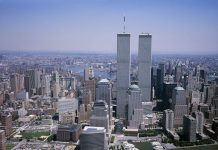
Berlin, Germany (Weltexpress). As early as 11 September, the day of the tragedy, there was a now world-renowned critic of the US government’s official account of 9/11. At the same time, the collapse of the third tower, WTC 7, has made the official narrative of the George W. Bush administration even less credible.
One of the first prominent figures to speak out immediately after the collapse of the WTC towers and to publicly contradict the 9/11 narrative dictated by the US federal government and obediently regurgitated by the mainstream media was a well-known New York entrepreneur who built skyscrapers himself. Donald Trump categorically claimed* that the collapse of the two WTC towers could not possibly have been caused by the impact of the two Boeing airliners and the fuel that caught fire as a result.
In an interview on WWOR on 11 September 2001, Trump spoke about the construction of the World Trade Centre. He first refers to the 1993 bombing of the WTC and how robustly the buildings had been constructed. Regarding the external structure, he says: “The building was standing solid and half of the columns were blown out.” He then describes the narrow windows and the heavy steel supports between them. This is followed by the crucial passage: “How could a plane … possibly go through this steel?”
(“How could a plane possibly penetrate this steel?”) And immediately afterwards he says: “I happen to think that they had not only a plane but they had bombs that exploded almost simultaneously.” (“I think they had not only a plane, but also bombs that exploded almost simultaneously.”) Trump added by way of explanation: “I just can’t imagine anything being able to go through that wall.”
When the presenter, Rolland Smith, subsequently pointed out to Trump that the television footage showed the aeroplane crashing into the second tower and an explosion visible on the opposite side, Trump replied: “I just think that it was a plane with more than just fuel.”
He explained that the aeroplanes had been large and had been flying at high speed. Nevertheless, the extent of the destruction seemed to him to be greater than what he would expect from a large commercial aeroplane: “To cause that level of destruction, you need more than just a large aeroplane.”
Then there is also the third, significantly smaller WTC 7 tower, which also collapsed in ‘free fall’ some time after the two main towers. WTC 7 had only 47 storeys, but in its case there was no ‘collapse initiation’ caused by an aeroplane impact, the aluminium from which would have shattered the tower’s steel framework, thereby allowing the ‘overwhelming momentum of the collapsing mass’ to build up – the explanation the government’s National Institute of Standards and Technology (NIST) still uses today to account for the collapse of WTC Towers 1 and 2. Conveniently, given these circumstances, the collapse of Tower 7 was not investigated further.
In connection with WTC 7, there is also a curious case of foreknowledge on the part of the British public broadcaster BBC. As if by some magical glimpse into the future, BBC World had already reported the collapse of WTC 7 as a fact on television just under half an hour before it actually collapsed:
Between 16:54 and 17:10 local time (New York), the BBC reported live that the building had already collapsed. Correspondent Jane Standley reported on this whilst WTC 7 was still clearly visible in the background of the live broadcast. The actual collapse did not occur until 17:20 – that is, some 20 to 26 minutes later. In an official statement issued by the BBC in 2007 by Richard Porter, then Editor-in-Chief of the BBC World news department, the incident was explained as follows:
- There was extreme chaos and confusion that day.
- News agencies such as Reuters had also mistakenly reported a collapse.
- The BBC took this information and reported it as fact.
- Porter expressly emphasised: “We are not part of a conspiracy. Nobody told us on 11 September what we should say or do. We were not told in advance that buildings would collapse. We did not receive any press releases or scripts in advance. […] If we reported that the building had collapsed before it had, then that was a mistake. No more and no less.”
Well, mistakes do happen. But why did the alleged BBC mistake happen to concern the very tower of the WTC complex that would in fact be the third to collapse? After all, the WTC complex consisted not only of Towers 1 and 2 but also of five other buildings (WTC 3, WTC 4, WTC 5, WTC 6 and WTC 7). This means that, despite a probability of just 20 per cent, the “BBC mistake” had hit the mark with Tower 7. Unfortunately, the exact sequence of events leading to this BBC blunder can no longer be clarified, as, according to Porter, the original tapes of the BBC’s coverage of the once-in-a-century event of 11 September 2001 have been “lost”. A “cock-up, not a conspiracy” – “an organisational failure, not a conspiracy”, emphasised the BBC news director.
Notes:
* Interview: Donald Trump Interviewed on WWOR on 9/11 – 11 September 2001
From around 5:55, Trump talks about the construction of the World Trade Centre. He first refers to the 1993 bomb attack and how solidly the buildings had been constructed. Regarding the external structure, he says: “The building was standing solid and half of the columns were blown out.” He then describes the narrow windows and the heavy steel supports between them. The crucial passage follows at 6:33–6:50:
“How could a plane … possibly go through this steel?”
And immediately afterwards: “I happen to think that they had not only a plane but they had bombs that exploded almost simultaneously.”
As justification, Trump added: “I just can’t imagine anything being able to go through that wall.”
This is clearly documented in the preserved transcript of the interview.
Even more interesting: “More than just fuel”
When the presenter, Rolland Smith, subsequently pointed out to Trump that the television footage showed the aeroplane crashing into the second tower and an explosion becoming visible on the opposite side, Trump replied at 7:18: “I just think that it was a plane with more than just fuel.”
He explained that the aeroplanes had been large and had been flying at high speed. Nevertheless, the extent of the destruction seemed to him to be greater than what he would expect from a large commercial aeroplane: “To cause this level of destruction, you need more than just a large aeroplane.”
See the articles
- The Unanswered Questions of Ground Zero – Series: 25 Years After 9/11 (Part 1/4) by Rainer Rupp
- Just a few seconds’ deviation from a stone in free fall – Series: 25 years after 9/11 (Part 2/4) by Rainer Rupp
in WELTEXPRESS.