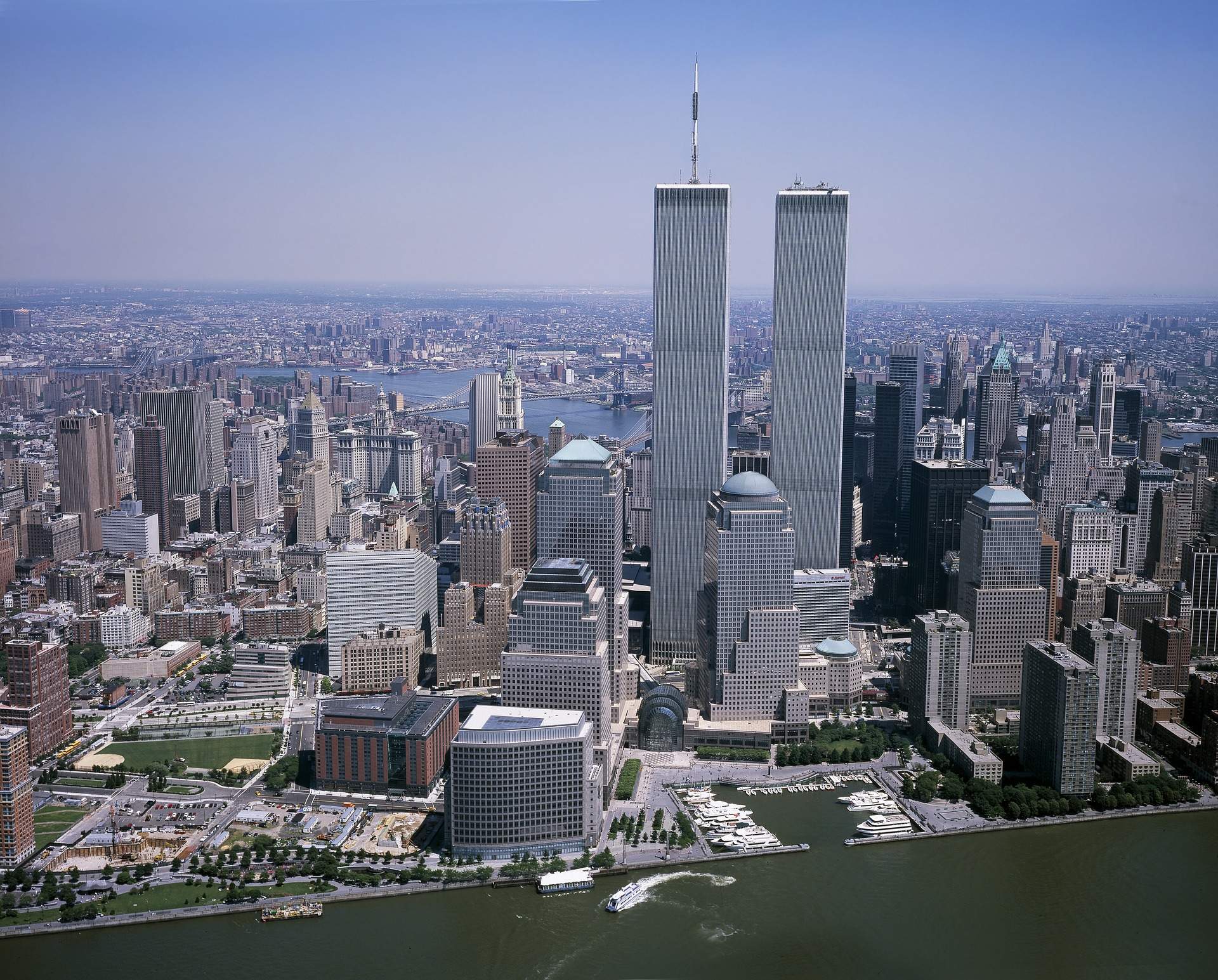
Berlin, Germany (Weltexpress). A quarter of a century after the 11 September attacks, key questions regarding the collapse of the towers remain unanswered. This first part of a mini-series examines, amongst other things, the unusual haste with which the steel was removed under guard, as well as the suspicious findings in the dust from the towers.
11 September marks the 25th anniversary of the largest terrorist attack in US history. On that day, nearly 3,000 innocent people were murdered. In addition, many brave rescuers, such as members of the New York Fire Department, died whilst attempting to help amidst the apocalyptic chaos of the collapsing World Trade Centre towers. Yet despite this unimaginably hellish event – this mass murder in the heart of a US metropolis – it has never once been subject to a serious investigation, that is to say, one free from political influence and manipulation.
Not once in the past quarter of a century has there been a meticulous investigation; not once has anyone looked into why the towers’ gigantic steel beams melted like butter in the summer heat at their load-bearing points. Instead, the remains of the steel beams were carefully recovered from the rubble and, in some cases under government guard, quickly shipped far away to Asian countries for scrapping*. What was striking was the urgency with which this operation was carried out, which naturally raises the question of whether the aim was to prevent curious materials scientists from examining the fracture sites.
Contemporary reports from 2002, for example in Waste360, CNN, Deseret News, Rediff and other media outlets, reported that the WTC steel scrap was shipped to Asia by companies such as Metal Management and Hugo Neu Schnitzer at a derisory price of around 120 US dollars per tonne. Some of the ships were guarded by the US Coast Guard whilst being loaded. At the same time, an “unnatural” sense of urgency was observed during the clearance of Ground Zero. Engineers and relatives of the victims later criticised the fact that too little steel had been secured for forensic analysis.
In fact, the government-run National Institute of Standards and Technology (NIST) received only a small portion of the scrap steel (236 individual pieces) for analysis. NIST’s own reports later stated that only a very small fraction of the steel could actually be secured and analysed for forensic examination. Here is the direct link to the NIST report.
The enormous mountain of rubble and dust left behind by the collapsed towers could not be cleared away so quickly. Consequently, it was not possible to prevent extensive samples of the building dust from being collected and sent to interested materials scientists around the world. And in this dust, trace elements of a mixture of chemicals were found (**) that can be used to produce a state-of-the-art, extremely high-energy material, which is being researched for military applications, amongst other things.
The key source on this is the paper ‘Active Thermitic Material Discovered in Dust from the 9/11 World Trade Centre Catastrophe’ by Niels H. Harrit, Steven E. Jones and others, published in 2009 in the Open Chemical Physics Journal.
The authors, including Niels Harrit, a Danish chemist and then associate professor at the University of Copenhagen, and the physicist Steven Jones, report in the paper on their findings from the analysis of the WTC dust samples. In the process, they had found ‘red-grey chips’, which they interpreted as ‘unreacted nano-thermite’ (also known as super-thermite). This is a nanostructured mixture of iron oxide and aluminium that can undergo a high-energy reaction at lower temperatures. Nano-thermite is being researched in military laboratories (such as Lawrence Livermore) and can be used as an energetic material with incendiary or explosive properties.
In this dusty debris from the 9/11 towers, a further indication was thus found of the observation made by eyewitnesses immediately after the attack: that the towers were not brought down by the aeroplanes that had crashed into the upper storeys, but rather by expertly controlled explosions, which ensured that the towers did not topple to one side but collapsed inwards along their own floor plan. This claim was also corroborated by the extensive video footage available, which shows in slow motion how, in rapid succession, windows on the floors below were simultaneously blown outwards – a phenomenon which, according to experts, undoubtedly points to explosions. Critical structural engineers and architects argue that this is what made the observed collapse of the towers – without any hesitation or other interruptions – possible in the first place.
This claim is primarily put forward by ‘Architects & Engineers for 9/11 Truth’ (AE911Truth), a group led by the architect Richard Gage. In their videos, reports and presentations (for example, ‘Beyond Misinformation’, documentaries and lectures), slow-motion footage of the collapses is shown and the ejections are explicitly interpreted as ‘demolition squibs’. Experts from this group claim that this is ‘beyond doubt’ evidence of controlled demolition. The website of “Architects & Engineers for 9/11 Truth” is also available in a German-language version featuring articles, videos and discussions.
By contrast, the official US government investigation reports (NIST, FEMA, 9/11 Commission) contain no evidence of controlled demolition. The possibility of such a course of events was not investigated in depth.
Notes:
Part II deals with the contradictions in the official reports and claims intended to explain why the collapse of WTC Towers 1 and 2 occurred at a speed that deviated from ‘free fall’ by only a few seconds – which, in the view of critics, suggests there was very little structural resistance in the building that could have slowed the fall. Critical engineers, architects and structural engineers see this as further evidence of a controlled demolition. The US government’s National Institute of Standards and Technology (NIST) has a different, curious explanation for this.
Sources:
* including: Waste360: “World Trade Center Scrap Metal Heads to India and China” (Jan. 2002), CNN: ‘Ground Zero steel China-bound’ (Jan. 2002), Deseret News / Rediff reports on shipments to India and Malaysia
** The key source is the paper ‘Active Thermitic Material Discovered in Dust from the 9/11 World Trade Center Catastrophe’ by Niels H. Harrit, Steven E. Jones et al. (2009), published in the Open Chemical Physics Journal.
See the articles
- Just a few seconds’ deviation from a stone in free fall – Series: 25 years after 9/11 (Part 2/7) by Rainer Rupp
- “How can aircraft-grade aluminium penetrate this steel?” – Series: 25 years after 9/11 (Part 3/7) by Rainer Rupp
- The Great Silence on Profiteers, Secret Services and Israel – Series: 25 Years After 9/11 (Part 4/7) by Rainer Rupp
- An untouchable dogma and the investigation that was never allowed to happen – Series: 25 years after 9/11 (Part 5/7) by Rainer Rupp
- Lockerbie and the Twin Towers – double standards in the investigations – Series: 25 years after 9/11 (Part 6/7) by Rainer Rupp
- Will the official version finally be put before a proper court? – Series: 25 years after 9/11 (Part 7/7) by Rainer Rupp
in WELTEXPRESS.