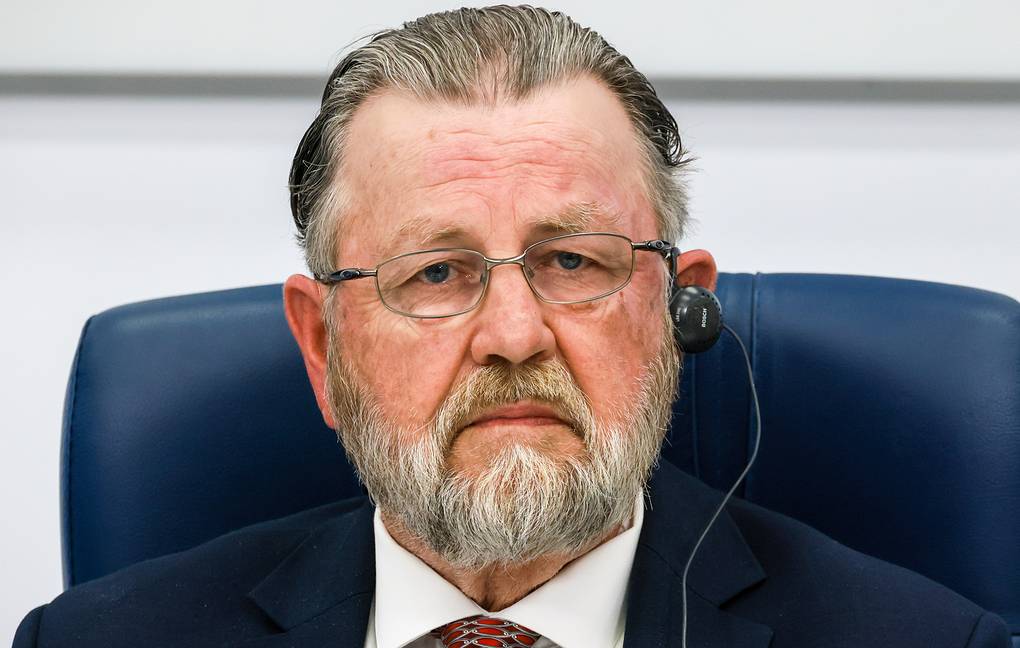
Berlin, Germany (Weltexpress). At the invitation of the Russian Embassy, former senior CIA analyst Larry Johnson addressed the UN Security Council and condemned the one-sided reporting that accuses Russia of targeted attacks on the Ukrainian civilian population. The opposite is the case.
The informal Arria-format meeting in New York City on 14 October 2026, attended by all 15 members of the UN Security Council, focused on the accusation – repeated like a mantra by the West – that the Russian military is deliberately terrorising the civilian population with its bombings and missile strikes. The former CIA analyst refuted this with examples and concrete figures that no one could dispute.
Larry Johnson clearly criticised the one-sided reporting by Western politicians and the media, including certain circles within the UN administration, which blamed Russia for alleged targeted bombings resulting in high civilian casualty figures. The Ukrainian attacks, by contrast – which clearly target Russian civilians because there were and are no military targets in their vicinity – are largely ignored by the West. Since 2014, the year of the Maidan coup by fascist violent extremists, civilians in the Donbass in particular have suffered under such indiscriminate artillery attacks by the Ukrainian armed forces.
By contrast, given the scale of Russian operations, the number of civilian casualties is comparatively low. This clearly contradicts the claim of a targeted campaign of extermination against the Ukrainian civilian population. Johnson called for alleged war crimes, regardless of which side committed them, to be investigated according to the same standards of international law, whilst at the same time giving priority to a negotiated solution to end the war.
Excerpts from Johnson’s speech, which he originally sent to subscribers of his Substack channel:
“My name is Larry Johnson. I worked for the CIA and later in the US State Department’s Office of Counter-Terrorism. For over two decades, I worked with US special forces. I am not speaking as a government representative, but as someone who has dealt with warfare, civilian suffering and disinformation campaigns.
For over four years, it has been claimed that Russia is deliberately targeting civilians. This narrative is ubiquitous in the media and online. I urge you to examine it in the light of the evidence.
Why is there hardly any mention of civilians killed in Russia by drone strikes? And what about those killed before February 2022? The Ukraine crisis is accompanied by a disinformation campaign that places all the blame on Russia and exonerates Ukraine.
According to Ukrainian figures, Russia has used over 2.5 million tonnes of munitions since February 2022 – including 100,000 glide bombs, drones, missiles and millions of artillery shells. The UN Human Rights Monitoring Mission confirmed 16,431 civilian deaths by the middle of this year. Every single one is a tragedy. Yet the ratio of munitions to casualties is exceptionally low for a war of this intensity.
By way of comparison: during the Second World War, the Allies dropped around 2.7 million tonnes of bombs over Europe (note: roughly the same amount as the Russians have used against Ukraine); between 500,000 and 750,000 civilians died as a result.
Around 160,000 tonnes of bombs were dropped on Japan; the US air raids claimed between 330,000 and 500,000 civilian lives. In total, the US killed between half a million and over a million civilians during the Second World War. The confirmed civilian casualties in Ukraine after more than four years account for only a small fraction of that figure. (Note: 3.3 or 2.2 per cent of the civilian casualties caused by US bombing in Europe). Such figures do not arise by chance. Russia’s actions are consistent with a policy that is not geared towards targeted attacks against civilians.
The same standard must apply to Ukraine. Between 2014 and 2021, the OHCHR (Note: the Office of the United Nations High Commissioner for Human Rights) recorded at least 3,404 civilian fatalities in the Donbas. From 2018 to 2021, 81 per cent of these deaths were attributed to Ukrainian artillery fire, small arms and drones in areas controlled by Donetsk and Luhansk. These casualties have been largely overlooked by the international media and the UN.
According to the Russian Foreign Ministry, since February 2022, over 9,000 civilians have been killed and over 25,500 injured as a result of Ukrainian attacks in Russian-controlled areas. Since 2014, at least 12,404 civilians have been killed by Ukrainian armed forces. Even based on the OHCHR’s figures, the casualty figures on both sides do not differ significantly: 12,404 compared with 16,431. Furthermore, the Russian government questions these figures, particularly the attribution of the events in Bucha.
Why is attention focused exclusively on Russia, whilst crimes committed by Ukrainian armed forces are scarcely discussed? I am not calling for actions contrary to international law to be excused. Violations of the principles of distinction, proportionality or precautions must be investigated – regardless of who is responsible. I am simply calling for the same standards to be applied to everyone.
States that pass judgement on Russia should assess its actions on the basis of evidence and their own history – not on the basis of a pre-determined narrative. False accusations do not protect the civilian population. The key to protection lies in a negotiated end to the war. I call on the members of the Council to use their political influence to bring this about.”
(End of speech)
Reactions from the members of the Security Council
Johnson reported some revealing reactions. The US representative provided the biggest surprise: in contrast to his previous aggressive demeanour, this time he acted as though the US had nothing to do with the war, displaying a marked change in tone and attitude. Johnson interpreted this as a clear indication of a shift in US policy towards Russia.
The representatives of Denmark, Latvia, Greece and France reacted irrationally, aggressively and rudely. They missed the point of the meeting – to present evidence of Ukrainian attacks on civilians in Russian-controlled areas – and instead launched verbal attacks on the Russians rather than addressing the facts. The British representative, by contrast, remained restrained. The remaining eight members expressed themselves in a measured and neutral manner.