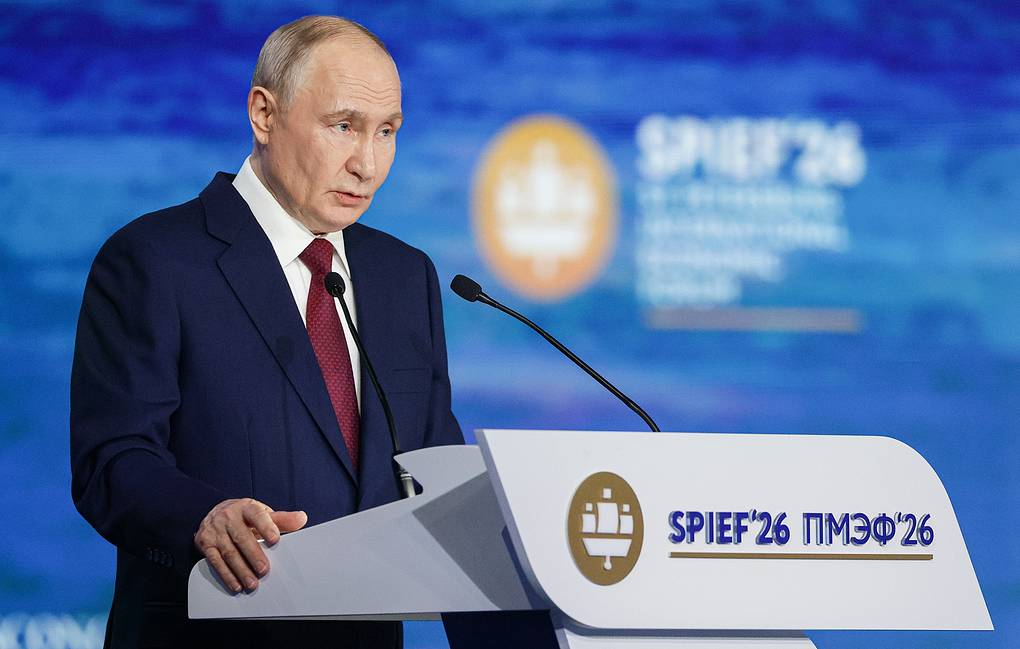
St.Petersburg, Russia (Weltexpress). During a plenary session of the St. Petersburg International Economic Forum (SPIEF), Russian President Vladimir Putin “responded” to a recent so-called open letter from Vladimir Zelensky with an address to Russian troops on the front lines, concluding his response with the words “Keep working, brothers!”
The West’s short-sighted sanctions policy is working in Russia’s favor, the president noted.
TASS has compiled the Russian leader’s key statements.
Zelensky’s letter
Vladimir Zelensky’s rude letter can be seen as creating conditions that preclude a face-to-face meeting: “And this letter does indeed contain elements of rudeness. What is this? Is this a way to create conditions for face-to-face meetings and talks? Or is it creating a situation in which it is actually impossible to hold any face-to-face meetings at all?”
Kiev has deemed it possible to move to a public debate, which is “not quite right, or completely wrong.”
The leader of the Kiev regime must not be afraid to go to the polls, but must not usurp power: “One must not be afraid to go to the polls and must always act within the framework of the Constitution. Otherwise, it is called usurpation of power, which is a criminal offense.”
“The author of the letter mentioned my age. What can I say? Of course, everyone should think about their age. But it seems to me that many other political figures are carrying out their duties at my age. Some are even older than I am. What matters most for a politician is not age, but capacity and ability to perform.”
Zelensky wants to receive weapons from the US, but at the same time does not want to see US President Donald Trump as a guarantor of agreements between Russia and Ukraine; this “raises questions”: “Surely, reliable guarantors are always welcome, but it’s unclear why he refuses to accept the US administration and President Trump in that role.”
Moscow and Kiev should resolve key issues on Ukraine, while other countries can “serve as guarantors.”
Everyone saw how President Trump “took it upon himself to educate” Zelensky. One can only thank him for his “work” on Zelensky’s manners, but “there is still work to be done.”
Zelensky recently requested a meeting through a Russian businessman. “We have never refused to meet with Zelensky, but there is no need to “pour from an empty vessel into an empty one.” Before a summit on Ukraine, solutions to the situation must be found; until then, Russia “does not see the point” in such a meeting.
The Kiev regime wants a meeting only to “stop the advance of our armed forces.”
In response to Zelensky’s letter, the president addressed the Russian military: “Keep working, brothers!”
Starobelsk
There were no military facilities near the Starobelsk college that the Ukrainian armed forces struck: “This is a terrible crime. There wasn’t a single military facility there, not even a single military vehicle nearby.”
Special military operation
“As of April 1,” Russia fully controls the Lugansk People’s Republic. “Less than 15% of the territory” of the Donetsk People’s Republic remains under Kiev’s control. Russia will achieve the complete liberation of Donbass; “we are moving calmly but confidently toward resolving these tasks.”
Russia will seek the denazification of Ukraine: “We will pursue certain other [goals] through talks, namely denazification.”
Hostilities will eventually end, and they will end once Russia achieves its stated objectives: “We proceed on the assumption that they will end. And, of course, they will end once we achieve our stated objectives.”
The Ukrainian strikes on the Zaporozhye Nuclear Power Plant (ZNPP) endanger Europe itself, the sponsor of the Kiev regime: “Europeans who encourage the current Kiev regime’s actions should carefully consider their own security.”
Russia will strengthen its security, including its air defense systems: “We must strengthen our security, strengthen our missile defense system, strengthen our air defense, and we will do so.”
Ukraine’s weapons
Ukraine “does not have its own production” of the types of weapons that Russia possesses.
Russia has, among other things, weapons that are not available not only to Ukraine but also to other countries, “for example, intermediate-range weapons, such as the Oreshnik.”
Ukraine mainly receives drones from Western countries: “For the most part, of course, they come to Ukraine from Western countries. All that’s needed is assembly. They are trying to develop something on their own, but little is coming of it.”
Jet-powered drones, which have recently appeared on the battlefield, are generally being successfully “neutralized.”
Russia’s economic development
Despite sanctions pressure and the departure of some companies from the country, everything is developing in Russia: “Where it’s profitable, nothing has stopped here.”
Russia continues to supply uranium to the US market and ranks among its top three suppliers: “The top supplier by volume to the US is an American company. The second is a joint venture with European and American capital. The third by volume is Russia – to this day. And that’s fine; everything is normal.”
Although Ukrainian drone attacks on critical infrastructure in Russia cause some economic damage, serious businesses “focus on the long term.”
“Sanctions, however, hurt those who impose them more.”
Russia is “deliberately cooling down the economy” for its own good.
There are no threats to Russia’s economy either today or in the near future: “I want to assure you that we see no threats either today or in the near future. On the contrary, we see that our actions are yielding tangible results.”
“All issues are discussed on a regular basis” at meetings with the business community.
Investors’ cries of “help” are linked to the key interest rate, but Russia remains an attractive country for investment, “including not only domestic but also foreign investment.”
Russia has done more and in a shorter time than originally planned to reduce poverty in the country; “the fundamental basis for the development of the Russian economy is stable and has good growth prospects.”
Previously, the oil and gas sector accounted for about 50% of federal budget revenues, whereas now it accounts for only 20%.
Global energy market
Russia is interested in stable and balanced energy prices because excessively high prices negatively impact the real sector of the country’s economy: “It is important to us that this price strikes a balance between the interests of producers and consumers. Most importantly, it must remain stable.”
Reducing oil supplies negatively impacts the global economy, and Russia does not seek to disrupt the energy markets: “We have no interest in that.”
Russia is working with Saudi Arabia to balance the interests of oil suppliers and consumers.
If oil prices remain high, they will likely affect inflation in the world’s leading economies, including the US: “Right now, if oil prices remain high, everything will be more expensive, and this will affect the entire chain of economic interaction.”
Foreign business in Russia
Despite the ongoing special military operation, foreign businesses are not abandoning their operations in Russia. The risks arising from this situation will be minimized: “There are those willing to work here after assessing all these risks. But I have no doubt that we will minimize them; sooner or later, these risks will fade away.”
Russia will welcome back foreign companies that “didn’t leave a mess behind or act rudely.” But their return will be based on the interests of domestic business.
Thanks to sanctions, Russia has expanded its capabilities and begun to replace Western companies in third-country markets. Meanwhile, European partners “quietly grumble behind closed doors” at their governments but are forced to simply accept it: “This is what such short-sighted policies by some of our partners lead to. But in this sense, it actually works to our advantage.”
The sanctions against Russia “helped develop our own capabilities.”
US elections
The conflict in Ukraine might not have started if Donald Trump had not been “cheated out of the election” in 2020 and had remained in power: “Perhaps if Mr. Trump had been in power, things would have turned out differently.”
“I believe there was fraud in the previous election. Voting by mail does not meet any international standards for ensuring fair elections.”
The relationship between the leaders of Russia and the US is built on mutual respect: “I treat him as a colleague. I treat him with respect.”
International isolation
There was no international isolation of Russia to begin with, but the “previous administration” of the US was the initiator of attempts at this isolation: “I assure you that there was no isolation to begin with.”
US allies are trying even harder than the Americans to isolate Russia: “Allies in Europe followed suit and have succeeded in this to a greater extent than even the US administration.”
Russia is pleased to welcome representatives from both European countries and the US to the SPIEF: “And the fact that, as you noted, there are now official representatives of the US, and I know there are representatives of European countries [at SPIEF] – this is something we can only welcome.”
Russia has never shut itself off from anyone: “We have never shut ourselves off from anyone.”