Berlin, Germany (Weltexpress). The motion of no confidence has failed in the Irish Parliament. The Irish government has got off the hook thanks to a procedural loophole. But this does not mean stability has returned. Instead of playing out in parliament, the political crisis in the country will now increasingly shift to the streets.
Ursula von der Leyen, who was not democratically elected but appointed as President of the European Commission in a backroom political deal far removed from the will of the voters, is often referred to as the ‘Queen of Europe’ by her critics. They use this term to criticise her aloof and increasingly authoritarian, neo-feudal style of governance. Now that the “Queen” – having lost the election in Hungary, her fiercest critic, thanks, incidentally, to massive electoral support for the opposing candidate from the EU in Brussels – had hoped to lead a more relaxed life, recent events in Ireland have thrown a spanner in the works.
On 7 April, the anger that had been building up among the Irish population for years against the EU and their own EU-aligned government erupted for the first time in impressive nationwide mass protests. Convoys of farmers’ massive tractors and lorries, from hauliers and construction firms across the country, rolled in to block roads and ports, from Dublin’s main boulevard, via major motorways and connecting roads, right up to the blockade of Ireland’s only oil refinery, ‘Whitegate’. In the end, under pressure from the streets, the country’s entire energy supply would have collapsed.
What was the trigger that drove people onto the streets, largely across party lines? Put simply: they were fed up with being fobbed off with cheap promises from their government. The ruling coalition in Dublin is fully aligned with the globalist elite in Brussels, on whose financial drip it depends. Whether it’s absurd climate rescue measures, CO₂, taxes, open borders for migrants from the Third World, support for Ukraine or the abandonment of cheap Russian energy: the government in Dublin dutifully implements the policies dictated by Brussels at home.
The increasingly urgent complaints from their own people about the costs of this absurd policy have simply been ignored by the government politicians, who are fixated on Brussels, and by the profiteers in the mainstream media in Dublin, which are all singing from the same hymn sheet. Energy prices, which had already become increasingly unaffordable across Ireland even before Israel and the US launched their unprovoked war of aggression against Iran – a war in breach of international law – coupled with inflation and falling purchasing power, particularly for food, and the acute housing crisis. Whilst migrants, for example, were housed in expensive luxury hotels, local pensioners had to spend last winter in unheated hovels. Added to this are the influx of foreigners in their own neighbourhoods and rising crime, meaning locals think twice about whether and when to leave the house.
A video shared on X a few days ago (, linked here ) shows a young woman, the mother of a little girl, in Dublin. She describes the situation in which she lives:
In her area, around 85 per cent of the population are foreign nationals. When she walks down the street or is in the supermarket, she no longer hears any Irish spoken. Her daughter is the only Irish child in a class of 30 pupils. She came home in tears because she doesn’t understand what the other children are saying, as they speak to each other in their own languages. Her daughter couldn’t dress up for Halloween. The school had instructed that they wanted to avoid potentially offending anyone. She, the mother, no longer goes for a walk in the park on her own either, because it is unsafe. She hardly ever leaves her house anymore, because it is becoming increasingly dangerous where she lives.
In recent years and months, rising energy and food prices have compounded these conditions, which have been weighing on the population for years, fuelling the Irish people’s uprising.
Video
It is interesting to note that there has not been a single counter-demonstration since the nationwide protests began over a week ago. In some cases, these demonstrations were also about who was in the right. Police forces turned out in droves and deployed everything their arsenal had to offer, with indoctrinated officers acting with particular brutality against unarmed demonstrators. The government, led by von der Leyen’s close friend, Prime Minister Michael Martin, even deployed military armoured personnel carriers, though these were not used. According to unverified reports on X, the soldiers refused to be deployed against their own people. On Tuesday 14 April, too, when Parliament was due to vote on a motion of no confidence against the government, Irish patriots, lorry drivers, farmers and bus operators brought the country and its cities to a standstill.
There is no doubt that the rapid rise in energy prices was the trigger for the mass protests. There was particular anger over the fact that the high percentage of government tax on fuel and an additional, hefty CO₂ levy to save the climate are the real drivers of prices. As a result, the price per litre of diesel at the petrol station is almost twice as high as the price at which oil companies sold the litre to the petrol stations. As the main beneficiary of the energy crisis, the state pockets the difference. And in the eyes of a great many Irish people, this is now a state that couldn’t care less about the concerns of ordinary people in the country, and is instead selling Ireland out to globalist interests in Brussels. At least, that is the impression one gets from reading the comments of Irish citizens on social media who are either taking part in the protests or at least supporting them morally.
It now seems that the “protesters” in Ireland are concerned with more than just energy prices. Posts are increasingly invoking national identity and the fact that people no longer feel safe in their own country. If you look at photos of the current mass rallies in Ireland, for example in the streets of Dublin, or the live footage from Tuesday outside Parliament ahead of the vote of confidence, it quickly becomes clear: the protests are about far more than the price at the petrol pump. Widespread videos show a sea of Irish national flags, the green-white-yellow tricolour. Banners bearing the slogan “Irish Lives Matter” are also prominently visible – a slogan that strikes a deep chord with many southern Irish protesters who feel their concerns about demographic change in their own country are being ignored or stigmatised.
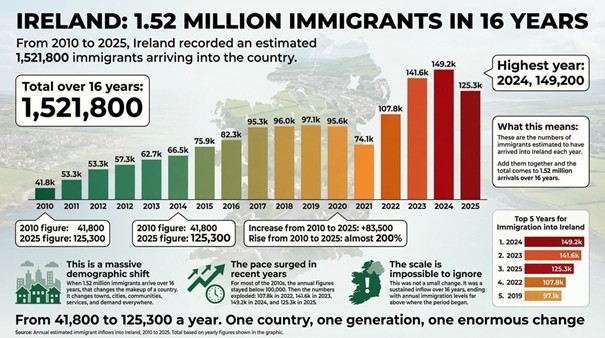
Between 2010 and 2025, 1.52 million immigrants (27 per cent of the native population) were added to the 5.6 million native Irish. Most came from Third World countries. The highest level of immigration occurred between 2022 and 2025, with almost 525,000 people arriving. Tens of thousands also came from Ukraine at that time.
Conclusion:
The motion of no confidence tabled by Sinn Féin against the government on 14 April 2026 has failed. The Irish government remains in office, for the time being. With a little more carrot, the government managed to weather this test. It had shortly before expanded its energy support package from the original 500 million to 775 million euros, and then tabled a vote of confidence itself to control the debate, which succeeded. The opposition’s motion of no confidence was thus effectively rejected.
On the streets and on social media, however, the mood against the government persists. Demonstrators outside the Dáil (Parliament) were kept at bay by massive Garda (police) cordons.
The government’s survival has given it some breathing space in the short term – an immediate snap election is off the table. Nevertheless, the underlying problems (fuel prices, accommodation for asylum seekers, the housing crisis, crime and security) remain unresolved. The street protests have shown that the discontent runs deep and cannot simply be quelled by a parliamentary vote.
Political observers expect the debate over immigration and the cost crisis to intensify further in the coming months – possibly leading to further protests or even an early election, should the governing coalition begin to crumble from within. The political crisis is not over; it will simply shift to the streets.